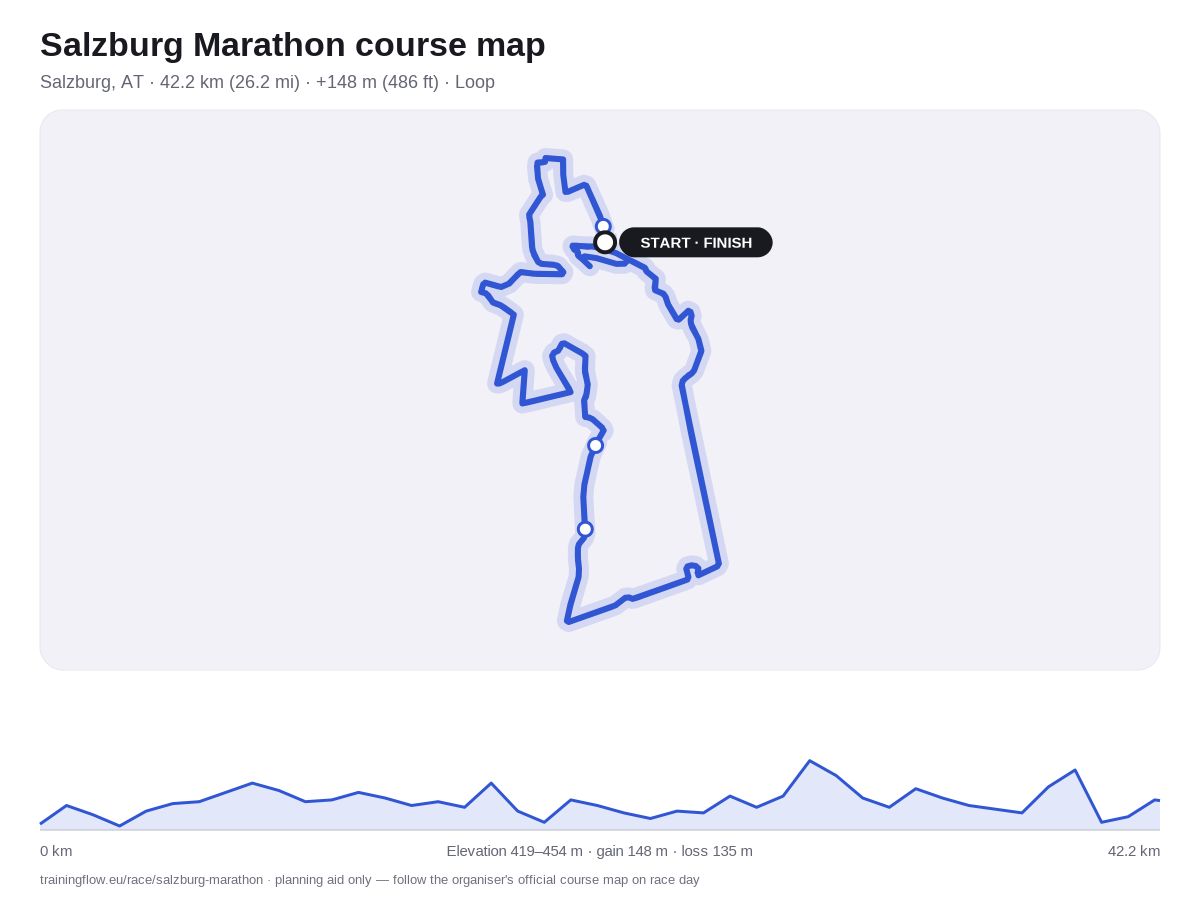
Salzburg Marathon course map & elevation profile
Salzburg Marathon pacing strategy with per-km splits from your VDOT, adjusted for the typical 8–18 °C climate baseline in Salzburg.
- Distance
- 42.2 km26.2 miles
- Elevation gain
- 148 m486 ft, loss 135 m
- Course type
- Loopstart and finish together
- Typical start
- 09:00local time, May
- Typical weather
- 8–18 °C46–64 °F
- Time limit
- 6:00:00course cutoff
Salzburg Marathon sub-3 pacing checkpoints
Listed edition date: (medium date confidence). Salzburg Marathon official site
Salzburg Marathon course, kilometre by kilometre
Scroll to run it. The marker follows the route and the profile below it, stopping at the signature sections and the points where races are usually won or lost.
km0
Start
The gun goes at 09:00 local time in Salzburg. The course is a loop that returns to where it starts. Settle in — the first kilometres decide how the last ones feel.
420 m above sea level
km3
Full overhead sun
From here the sun is high: peak UV and radiant heat. Keep sunscreen on and run the shaded side of the road where you can.
419 m above sea level, +0.1% gradient here
km21.1
Halfway
Check in here. If the first half felt easy, the plan is working; if it felt like work, ease off now rather than at the wall.
430 m above sea level, -0.4% gradient here
km28.5
Steepest kilometre
The sharpest climb on the course: about 1.9% for a full kilometre. Run it on effort and let the pace go.
445 m above sea level, +1.9% gradient here
km32
The wall
Most runners crack near km 32, when stored carbohydrate runs low. Fuel before km 30, not at it.
429 m above sea level, +0.3% gradient here
km42.2
Finish
42.2 km done. The course closes 6:00:00 after the start.
433 m above sea level
A genuinely hard course
- Most runners crack near km 32 — fuel before km 30, not at it.
- Full overhead sun from km 3 — sunscreen and run the shaded side.
Course difficulty
5.2out of 10
Hard
Driven by 148 m of climbing. Harder than TCS New York City Marathon (5.2), easier than Boston Marathon (5.3) — tougher than 34% of the races we cover.
Salzburg Marathon weather: typical race-day conditions
8–18 °C46–64 °F
- Humidity
- 70%
- Heat cost
- +0.7%
Typical May conditions in Salzburg — a climate baseline, not a forecast. At about 13 °C (55 °F) and 70% humidity, our heat model slows an unacclimatised runner by roughly 0.7% compared with a cool day.
Sun and shade
- Sun in your eyes
- 12 km
- Sun on your back
- 4 km
- Side or overhead
- 27 km
in your eyeson your backsideoverhead
From km 3 the sun sits high overhead — peak UV and radiant heat, so keep sunscreen on and run the shaded side of the road where you can. Approximate: solar position from the route and a 09:00 start, for a mid-pack finishing time.
Aid stations
8listed on the course
- km 5 water, sports drink, gel
- km 10 water, sports drink, gel
- km 15 water, sports drink, gel
- km 20 water, sports drink, gel
- km 25 water, sports drink, gel
- km 30 water, sports drink, gel
- km 35 water, sports drink, gel
- km 40 water, sports drink, gel
Confirm positions and supplies with the organiser for your edition.
Next edition
16 May 2027
Typical race-day conditions
8–18 °C
We lock the real forecast into your plan in race week.
Your Salzburg Marathon pace, adjusted for this course
Enter one recent result. The engine prices in the climbs, the descents and the typical weather, and shows what this course costs you before you sign up for anything.
Step 1 · Free preview
See the course-adjusted plan first
Enter one recent result. The preview returns course cost, first splits, and fuel target from the deterministic engine and the current course data model.
VDOT
49.1
Estimate
3:16:28
Course cost
+2:43
Fuel target
60 g/h
60 g/h needs a trained gut — practise it in training, never try new fuelling on race day. Your full plan tunes this to your experience.
First 5 km preview
full race locked
- km 14:56
- km 24:41
- km 34:40
- km 44:52
- km 54:47
First race free · then €7 Race Pass · no monthly subscription
Uses an approximate course model; verify final logistics against the official race packet.
Step 2 · Your full Salzburg Marathon plan
The preview shows the shape. The plan races it for you.
Course preview
Free
what you see now
- Difficulty score & course data
- Course-cost & toughest km
- Your first full plan free, ever
Race Pass
€7
one-time, this race
- Every km split, weather-adjusted
- Nutrition & fluid timeline
- Heat, wind & sun race tactics
- Danger zones + watch file (GPX)
- Race-week forecast & reminders
Annual
€19
per year, every race
- Everything in Race Pass
- Unlimited races, all year
- Re-plan as your fitness changes
No subscription required — one race is a one-off €7. See a full sample plan
Continue with approximate course dataSalzburg Marathon elevation profile
The Salzburg Marathon climbs 148 m (486 ft) and descends 135 m (443 ft) over 42.2 km (26.2 miles). The lowest point is 419 m and the highest 454 m above sea level. Move across the chart to read the elevation and gradient at any point.
Salzburg Marathon course map
Follow the Salzburg Marathon route on the real streets: press play to travel the course from start to finish while the elevation profile tracks your position, or drag the slider to any kilometre.
Race overview
Salzburg is a scenic Austrian spring marathon with a mildly rolling profile and alpine-edge weather. The course rewards controlled pacing rather than aggressive early splits.
Reference nutrition
For a 70 kg runner finishing in 3:13:22 at 13 °C. Adjust to your weight and tolerance — these are ISSN-window targets, not prescriptions.
- Carbs / hour
- 60 g
- Total carbs
- 193 g
- Fluid / hour
- 640 ml
- Sodium / hour
- 500 mg
How hard is this course?
How the Salzburg Marathon compares to a flat sea-level course for four typical fitness levels. Computed from the route profile, mean course altitude, and typical race-week climate (13 °C / 70 % humidity). Your personal strategy uses your VDOT, per-km splits, nutrition timing, and the typical climate baseline for this static sample; paid strategies use Open-Meteo when a verified race date is inside the forecast window.
| Runner | Flat-course finish | Salzburg Marathon finish | Course cost | Adjusted pace |
|---|---|---|---|---|
| Beginner (VDOT 35) | 4:16:08 | 4:19:44 | +1.4% | 6:07/km · 9:50/mi |
| Intermediate (VDOT 45) | 3:28:17 | 3:31:13 | +1.4% | 4:58/km · 8:00/mi |
| Trained (VDOT 50) | 3:10:41 | 3:13:22 | +1.4% | 4:33/km · 7:19/mi |
| Competitive (VDOT 60) | 2:43:24 | 2:45:42 | +1.4% | 3:54/km · 6:16/mi |
Race data quality
Medium confidence
Edition-specific course details have not been human-verified
Elevation values are estimates derived from the stored route profile, not official surveyed measurements. Confirm the final route, aid-station positions and supplies with the organizer for your edition.
Elevation profile
Approximate course model
Paid strategy guardrail
Official race packet remains source of truth
- Published race organizer materials
- Public course maps and elevation references
- Historical climate normals for the race month
Salzburg Marathon FAQ
How hilly is the Salzburg Marathon?
Mostly flat with a few rollers; even pacing still works.
What is the typical weather on race day?
8–18 °C with 70 % relative humidity. Heat acclimatization makes a measurable difference when the race-week forecast trends warm.
Get your personalized strategy
The numbers above are samples. Sign up free and get the full Salzburg Marathon strategy from your VDOT, the current course model, Open-Meteo race-week forecast when available, and your nutrition preferences.
Get my Salzburg Marathon strategyFirst race free · €7 per additional race · €19/yr for unlimited
Related races
- Vienna City MarathonVienna · 142 m gain · typical 6–15 °CSalzburg Marathon vs Vienna City Marathon — which is harder?
- Zurich Marató BarcelonaBarcelona · 131 m gain · typical 8–16 °CSalzburg Marathon vs Zurich Marató Barcelona — which is harder?
- Generali Köln MarathonCologne · 100 m gain · typical 8–16 °CSalzburg Marathon vs Generali Köln Marathon — which is harder?
- Telenor Copenhagen MarathonCopenhagen · 76 m gain · typical 9–16 °CSalzburg Marathon vs Telenor Copenhagen Marathon — which is harder?
Also in May: BMO Vancouver Marathon course map · Prague International Marathon course map · Tamarack Ottawa Marathon course map · Innsbruck Alpine Trailrun Festival K110 course map · Transvulcania course map · Ultra-Trail Australia UTA100 course map
New to the marathon? Start with our marathon pacing strategy guide or run the VDOT calculator. Browse every course by difficulty.
Related articles
- Half Marathon Splits Calculator: KM and Mile Targets
Calculate half marathon pace and cumulative km or mile splits, check two-hour and 1:45 targets, and avoid rounding drift when printing your race card.
- Marathon Pace Band Calculator: Splits That Add Up
Build a marathon pace band with cumulative km or mile checkpoints, compare even and negative splits, and check rounding before printing your race plan.
- Marathon Pacing Strategies: Four Plans, Real Split Math
Four marathon pacing strategies with checkpoint times for 4:00 and 5:00, why banked time buys only 2.8 s/km per minute, and the 10-10-10 plan.
- Marathon Split Calculator: Exact KM and Mile Splits
Turn any marathon goal into exact kilometer, mile, halfway, and finish splits. Compare even and negative plans, rounding drift, and race-day adjustments.