Seville Marathon course map & elevation profile
Course route, elevation, weather and a personalised pacing plan.
- Distance
- 42.2 km26.2 miles
- Elevation gain
- 90 m295 ft, loss 90 m
- Course type
- Loopstart and finish together
- Typical start
- 08:30local time, February
- Typical weather
- 9–19 °C48–66 °F
- Time limit
- 6:00:00course cutoff
Seville Marathon sub-3 pacing checkpoints
Listed edition date: (high date confidence). Zurich Maraton de Sevilla official site
Seville Marathon course, kilometre by kilometre
Scroll to run it. The marker follows the route and the profile below it, stopping at the signature sections and the points where races are usually won or lost.
km0
Start
The gun goes at 08:30 local time in Seville. The course is a loop that returns to where it starts. Settle in — the first kilometres decide how the last ones feel.
13 m above sea level
km21.1
Halfway
Check in here. If the first half felt easy, the plan is working; if it felt like work, ease off now rather than at the wall.
10 m above sea level, -0.5% gradient here
km32
The wall
Most runners crack near km 32, when stored carbohydrate runs low. Fuel before km 30, not at it.
11 m above sea level, -0.1% gradient here
km42.2
Finish
42.2 km done. The course closes 6:00:00 after the start.
13 m above sea level
Also on the course
- Plaza de España Iconic landmark passed early in the loop through María Luisa Park.
- Isla de la Cartuja Wide, flat avenues on the former Expo '92 island — a fast, PB-friendly section.
- Guadalquivir riverside Riverbank stretch past the Torre del Oro toward the finish.
Flat and fast — a PB-friendly course
- Most runners crack near km 32 — fuel before km 30, not at it.
Course difficulty
4.9out of 10
Moderate
Driven by a flat, fast course with mild conditions. Harder than Seoul Marathon (4.9), easier than TCS Toronto Waterfront Marathon (4.9) — tougher than 16% of the races we cover.
Seville Marathon weather: typical race-day conditions
9–19 °C48–66 °F
- Humidity
- 68%
- Heat cost
- +0.9%
Typical February conditions in Seville — a climate baseline, not a forecast. At about 14 °C (57 °F) and 68% humidity, our heat model slows an unacclimatised runner by roughly 0.9% compared with a cool day.
Sun and shade
- Sun in your eyes
- 13 km
- Sun on your back
- 9 km
- Side or overhead
- 21 km
in your eyeson your backsideoverhead
No strong glare or overhead-sun stretches at this start time — the sun stays mostly to the side. Approximate: solar position from the route and a 08:30 start, for a mid-pack finishing time.
Next edition
21 February 2027
Typical race-day conditions
9–19 °C
We lock the real forecast into your plan in race week.
Your Seville Marathon pace, adjusted for this course
Enter one recent result. The engine prices in the climbs, the descents and the typical weather, and shows what this course costs you before you sign up for anything.
Step 1 · Free preview
See the course-adjusted plan first
Enter one recent result. The preview returns course cost, first splits, and fuel target from the deterministic engine and the current course data model.
VDOT
49.1
Estimate
3:16:12
Course cost
+2:27
Fuel target
60 g/h
60 g/h needs a trained gut — practise it in training, never try new fuelling on race day. Your full plan tunes this to your experience.
First 5 km preview
full race locked
- km 14:40
- km 24:46
- km 34:43
- km 44:44
- km 54:48
First race free · then €7 Race Pass · no monthly subscription
Uses an approximate course model; verify final logistics against the official race packet.
Step 2 · Your full Seville Marathon plan
The preview shows the shape. The plan races it for you.
Course preview
Free
what you see now
- Difficulty score & course data
- Course-cost & toughest km
- Your first full plan free, ever
Race Pass
€7
one-time, this race
- Every km split, weather-adjusted
- Nutrition & fluid timeline
- Heat, wind & sun race tactics
- Danger zones + watch file (GPX)
- Race-week forecast & reminders
Annual
€19
per year, every race
- Everything in Race Pass
- Unlimited races, all year
- Re-plan as your fitness changes
No subscription required — one race is a one-off €7. See a full sample plan
Continue with approximate course dataSeville Marathon elevation profile
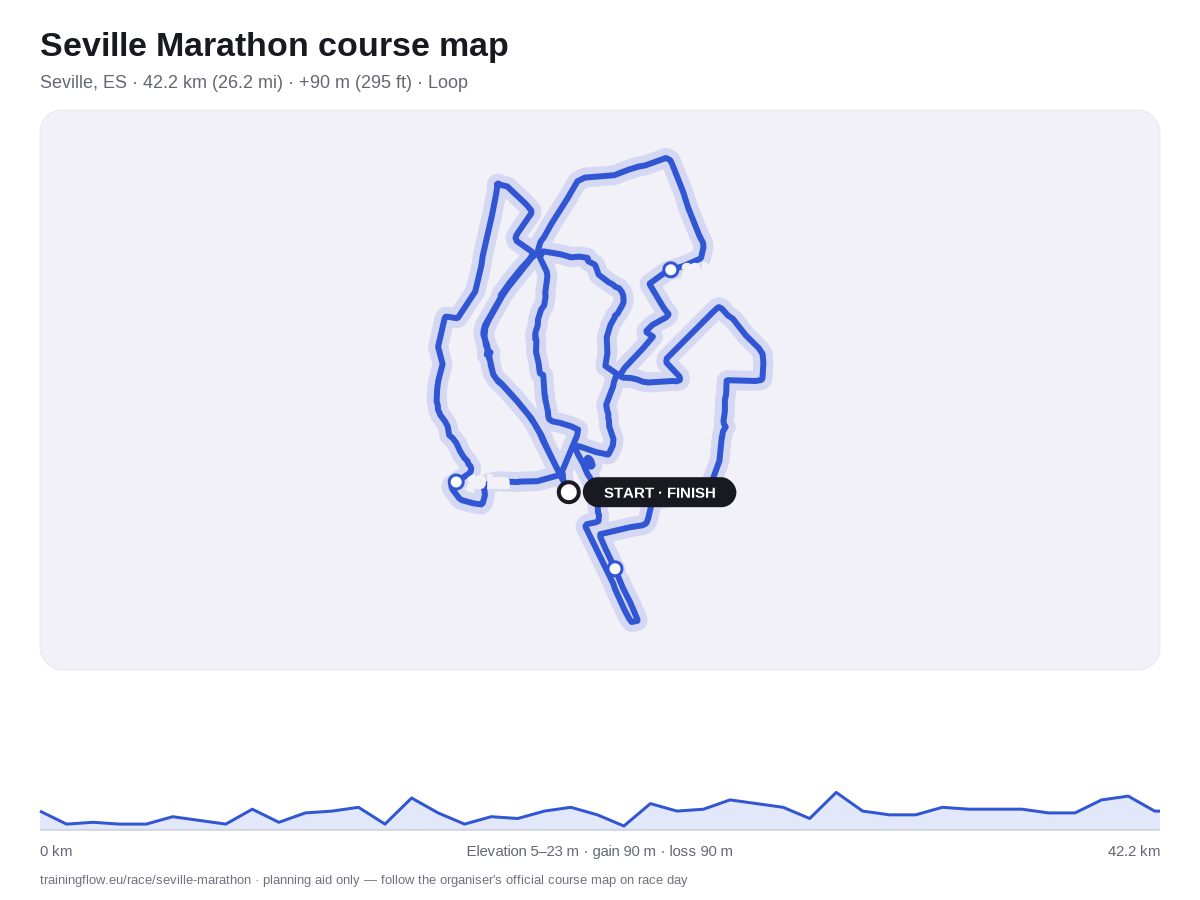
The Seville Marathon climbs 90 m (295 ft) and descends 90 m (295 ft) over 42.2 km (26.2 miles). The lowest point is 5 m and the highest 23 m above sea level. Move across the chart to read the elevation and gradient at any point.
Seville Marathon course map
Follow the Seville Marathon route on the real streets: press play to travel the course from start to finish while the elevation profile tracks your position, or drag the slider to any kilometre.
Race overview
A flat, single-loop road marathon through the historic centre and Cartuja island of Seville — widely regarded as Europe's flattest big-city marathon and a top PB / Olympic-qualifier course. It typically runs in February.
Reference nutrition
For a 70 kg runner finishing in 3:13:06 at 14 °C. Adjust to your weight and tolerance — these are ISSN-window targets, not prescriptions.
- Carbs / hour
- 60 g
- Total carbs
- 193 g
- Fluid / hour
- 640 ml
- Sodium / hour
- 500 mg
How hard is this course?
How the Seville Marathon compares to a flat sea-level course for four typical fitness levels. Computed from the route profile, mean course altitude, and typical race-week climate (14 °C / 68 % humidity). Your personal strategy uses your VDOT, per-km splits, nutrition timing, and the typical climate baseline for this static sample; paid strategies use Open-Meteo when a verified race date is inside the forecast window.
| Runner | Flat-course finish | Seville Marathon finish | Course cost | Adjusted pace |
|---|---|---|---|---|
| Beginner (VDOT 35) | 4:16:08 | 4:19:23 | +1.3% | 6:07/km · 9:51/mi |
| Intermediate (VDOT 45) | 3:28:17 | 3:30:56 | +1.3% | 4:59/km · 8:01/mi |
| Trained (VDOT 50) | 3:10:41 | 3:13:06 | +1.3% | 4:34/km · 7:20/mi |
| Competitive (VDOT 60) | 2:43:24 | 2:45:28 | +1.3% | 3:54/km · 6:17/mi |
Race data quality
Medium confidence
Edition-specific course details have not been human-verified
Elevation values are estimates derived from the stored route profile, not official surveyed measurements. Confirm the final route, aid-station positions and supplies with the organizer for your edition.
Elevation profile
Approximate course model
Paid strategy guardrail
Official race packet remains source of truth
- Official course GPX (goandrace) + Open-Elevation DEM
Seville Marathon FAQ
How far is Seville Marathon?
The distance in this course model is 42.2 km. Check the organizer's final course information for your edition.
How much climbing is in Seville Marathon?
The stored course model estimates 90 m of ascent and 90 m of descent. Elevation is an estimate, not an official surveyed measurement.
What weather can I expect at Seville Marathon?
The historical climate baseline is 9–19 °C with 68% relative humidity. This is not the race-day forecast.
When does Seville Marathon start and what is the cutoff?
The typical start is 08:30 local time and the stored cutoff is 6:00:00. Confirm your edition, wave and cutoff rules with the organizer.
Can I rely on the listed aid stations?
Aid-station positions and services are planning references until confirmed against your edition’s official race packet. Carry your practiced fuel unless the organizer confirms it is provided.
Get your personalized strategy
The numbers above are samples. Sign up free and get the full Seville Marathon strategy from your VDOT, the current course model, Open-Meteo race-week forecast when available, and your nutrition preferences.
Get my Seville Marathon strategyFirst race free · €7 per additional race · €19/yr for unlimited
Related races
- Zurich Marató BarcelonaBarcelona · 131 m gain · typical 8–16 °CSeville Marathon vs Zurich Marató Barcelona — which is harder?
- Valencia MarathonValencia · 130 m gain · typical 9–18 °CSeville Marathon vs Valencia Marathon — which is harder?
- TCS Amsterdam MarathonAmsterdam · 43 m gain · typical 10–16 °CSeville Marathon vs TCS Amsterdam Marathon — which is harder?
- Berlin MarathonBerlin · 68 m gain · typical 12–22 °CSeville Marathon vs Berlin Marathon — which is harder?
Also in February: Osaka Marathon course map · Black Canyon Ultras 100K course map · Tarawera Ultra-Trail Miler course map · The North Face Transgrancanaria Classic course map
New to the marathon? Start with our marathon pacing strategy guide or run the VDOT calculator. Browse every course by difficulty.
Related articles
- Half Marathon Splits Calculator: KM and Mile Targets
Calculate half marathon pace and cumulative km or mile splits, check two-hour and 1:45 targets, and avoid rounding drift when printing your race card.
- Marathon Pace Band Calculator: Splits That Add Up
Build a marathon pace band with cumulative km or mile checkpoints, compare even and negative splits, and check rounding before printing your race plan.
- Marathon Pacing Strategies: Four Plans, Real Split Math
Four marathon pacing strategies with checkpoint times for 4:00 and 5:00, why banked time buys only 2.8 s/km per minute, and the 10-10-10 plan.
- Marathon Split Calculator: Exact KM and Mile Splits
Turn any marathon goal into exact kilometer, mile, halfway, and finish splits. Compare even and negative plans, rounding drift, and race-day adjustments.